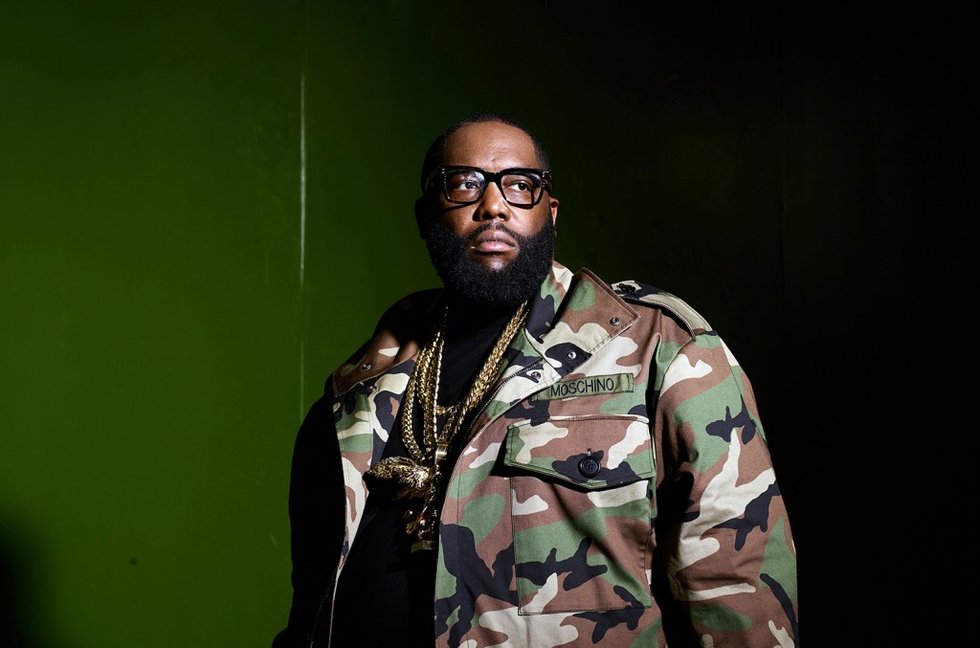
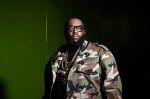
Killer Mike wants to invite you to church on Wednesdays.
The invitation is for Killer Mike’s Midnight Revival, a private first listen of his next album Michael that serves as a “midnight mass” held at The Cathedral in Austin during SXSW on March 15. Inside, the refurnished 1930s church has hand fans on benches for cooling off. A program with a foreword reads: “Killer Mike gets recognized for many things – being an Outkast protégé, a member of powerhouse Run the Jewels, one of Atlanta’s biggest advocates, a Bernie Sanders whisperer, and perhaps most importantly, a voice of reason in an increasingly insane world.”
After a serenade of worship songs from his choir, Killer Mike steps up to the podium. His gold chain, with a large statue of St. Michael Slaying the Devil, stands out. His audience is music industry professionals, artists like Blxst and Scotty ATL, and his Loma Vista Records label reps. He’s an eloquent speaker filled with passion, inviting us into his place of worship.
“I am proud to be a Southerner,” Killer Mike says. “I’m proud that my grandparents raised me in the Southern tradition. I’m proud my grandfather made me highly skeptical of preachers. He also taught me if you catch 50 fish, you keep 25 for yourself and you separate the other 25 for your neighbors.”
“I’m proud that my grandmother…” he continues — before pausing to fight back tears, sparking encouragement from the audience to keep going. “I’m proud that she took me to these little churches every Sunday and on Wednesdays.”
In his speech, the rapper/activist talks about growing up in a neighborhood “started by Black people for Black people” and how they understood the power of community. He is proud of Collier Heights and proud of the teachers who believed in him. Most of all, he is proud of Atlanta.
“I’m proud that God has put me before you tonight to play what I’ve worked on for two years,” he continued. “It’s not to see if you like it or not or if it has a club jam, it is simply for us to commune together and celebrate 20 years of a relationship that I’ve had with many of you.”
Over the course of the evening, supporting characters make their cameos in his self-described “audio movie.” There’s narration by Rico Wade. Cee-Lo Green appears on “Down by Law.” Backed by church organs and pianos, Dave Chappelle intros “RUN,” featuring Young Thug. Chappelle arrives late to the church service but is embraced nonetheless.
The Dungeon Family homages continue with “Scientists & Engineers,” featuring André 3000 and Future. Curren$y, 2 Chainz and Kaash Paige put together a banging Cutlass anthem over an Honorable C.N.O.T.E. beat for “Spaceship Views”. Blxst puts you in the heart of Adamsville and right by Martin Luther King Jr. Blvd on “Exit 9.” Run the Jewels returns with thankugoodsir, the formal introduction of Virginia songwriter Harold Lilly Jr., on “Don’t Let the Devil.” Detroit songstress Eryn Allen Kane lends her angelic voice to “Motherless.”
Michael’s release date is this Friday (June 16), after it was initially planned for April 20 on Killer Mike’s birthday. It’s a few days after Mother’s Day when he speaks about the album again over Zoom. “I consider myself fortunate that I’ve stayed hungry,” Killer Mike says. “Being denied something lights a fire in you, and being denied a proper opportunity to be me in full on an album has been much of the driving force [for making Michael] — I just want it to be understood, and seen for who I really am.”