

clear glass bottle
Photo by Roberta Sorge on Unsplash
bee happy
 black and white honey bee hovering near yellow flower in closeup photography
Photo by Boris Smokrovic on Unsplash
black and white honey bee hovering near yellow flower in closeup photography
Photo by Boris Smokrovic on Unsplash
Nature's Harmony: Bees and Blossoms Unite
black and yellow bee on yellow flower
 black and yellow bee on yellow flower
Photo by Tania P on Unsplash
black and yellow bee on yellow flower
Photo by Tania P on Unsplash
Pollination Perfection: Bees at Work
Shot on iPhone 6S with Olloclip Macro Lens attachment
 wasp on blooming white flower
Photo by Aaron Burden on Unsplash
wasp on blooming white flower
Photo by Aaron Burden on Unsplash
Nature's Harmony: Bees and Blossoms Unite
Don’t miss a thing
What matters in tech, in your inbox daily
Follow us on
When Dan Auerbach, best known as the singer and guitarist of The Black Keys, decided to launch his own record label in 2017, it was largely out of his love for the music he was working on.
“I had just been making so many records at that point, and I would make an album and give it to whatever label I was working for and it would just be, you know, kind of bittersweet,” Auerbach tells Billboard. “A lot of times I felt I had maybe something more to add in the label department.”
Six years later, he’s proved that to be true. The label, Easy Eye Sound — named after his recording studio in Nashville — has released more than two dozen albums, picked up 16 Grammy nominations and, in 2021, was named Billboard’s No. 1 Blues Imprint following a partnership it struck with Concord in February of that year. “Even in a Nashville landscape crowded with exceptional artistry, Dan has built something genuinely unique,” says Concord CEO Bob Valentine. “His commitment to talent and originality are clear on every album.”
The label is home to a mix of young, emerging acts (Nat Myers, The Velveteers, Early James), established artists (Yola, Shannon & the Clams, Hermanos Gutierrez) and veteran bluesmen (Robert Finley, Jimmy “Duck” Holmes), many of whom are releasing projects with Auerbach serving as producer. Already, the label has grown beyond just a vanity imprint for a successful rocker to use for whatever he’s working on at the moment, and into a full-fledged company, with five employees and a wide purview that extends across multiple genres.
“We have some real breakthrough artists, young and old, and we’ve shown that we’re able to help an artist through a career, not just one record,” he says. “We’re working with an artist like Shannon and the Clams for three albums, and they’ve doubled their shows and the amount of people that come to see them. Someone like Robert Finley, who was playing on the street when I first met him, this is now what he does for a living and he’s going back to France for the third time this year to play more shows. Those kinds of wins get me excited about future projects.”
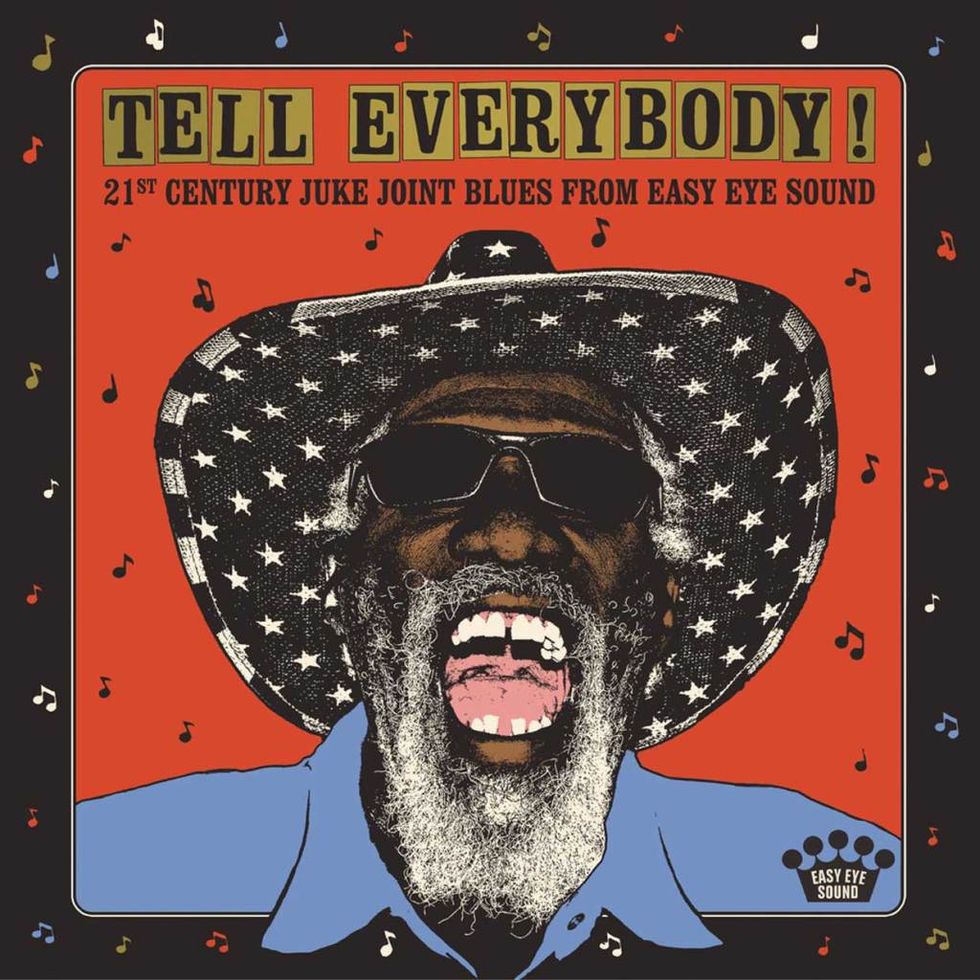
But its roots are in the blues, and Auerbach’s latest album, Tell Everybody!: 21st Century Juke Joint Blues From Easy Eye Sound, is a passion project that calls back to his earliest days playing music. The compilation features contributions from Finley, Holmes, Myers, RL Boyce, Gabe Carter, Moonrisers and the late bluesmen Leo “Bud” Welch and Glenn Schwartz, as well as a solo song by Auerbach and a Delta Kream outtake from The Black Keys.
“I’ve got stockpiles of songs — I’ve had the studio now for 13 years, and there’s hard drives full of music, hard-hitting, amazing-sounding records that we didn’t have scheduled to come out,” he says. “I was thinking about how great those early Fat Possum Records samplers were when I was younger, and how it really introduced me to a lot of my favorite artists. So I wanted to do something a little bit like that, to be able to showcase some of the artists that people know and then some ones that they don’t, some that they’ve never heard of and some that we’ve never done recordings of before.”
Building on that lineage of Fat Possum — which began in the early 1990s as a label dedicated to recording lesser-known Mississippi blues artists, before branching out — extended to a show that Auerbach and Black Keys drummer Patrick Carney hosted at Brooklyn Bowl in Nashville earlier this month, which brought the living contributors of the record together to perform live. That show was an homage of sorts to the Fat Possum Juke Joint Caravan shows of the 1990s and early 2000s, where the label would package artists like R.L. Burnside, “T-Model” Ford and Paul “Wine” Jones for a revue that would tour the country. “That was a really beautiful moment for us, and it felt very natural, too, because the music is such a big part of who we are,” Auerbach says. “It’s good for the soul, you know?”

That may mean more compilations on the horizon — Auerbach said that drummer Kenny Kimbrough, guitarist Eric Deaton and guitarist Kenny Brown were in town for the show, and they “may or may not have” gone into the studio to record afterwards — but he and Easy Eye Sound have plenty going on in the interim. There’s a new Black Keys album on the way, which he says is “taking shape now,” and Easy Eye Sound is reissuing Auerbach’s 2009 solo album Keep It Hid on Sept. 29, with new artwork and six new vinyl variants. But the blues is never far from his mind.
“It’s just so raw and unpretentious, like unrefined beauty. Something that you can’t really study in school,” he says. “It’s just a very free-flowing, f–kin’ wild music, you know? And I just loved it for so many different reasons.”